Thyroid gland
Part 2
Physiology and Grave's disease (hyperthyroidism)
How does the thyroid gland synthesizes the thyroid hormones?
The hypothalamic pituitary thyroid axis
First of all, the thyroid gland hormones are T3 (Triiodothyronine), T4 (Thyroxine), and Calcitonin, iodine is an essential element for the synthesis of these hormones, the thyroid gland is situated in front of the trachea below the hyoid bone ( the only floating bone), Moreover, the thyroid gland is very crucial to our body's metabolism at which it tends to make sure that the cells in your body are working properly by instructing every cell in the body when to consume oxygen and nutrients making it responsible for our growth and providence of better health, Furthermore, the calcitonin secreted by the thyroid gland, is an essential hormone that reduces your body's calcium level in the blood when it goes haywire, Ultimately, the thyroid gland allows our cells to use energy, grow and reproduce.
It begins when a part of the brain called hypothalamus secretes TRH (thyrotropin-releasing hormone) stimulates the pituitary gland to release TSH (thyroid stimulating hormone) which induces the thyroid gland to release its hormones, usually there is a negative feedback when the thyroid hormones are too much in the blood that should eventually inhibit the release of TRH from hypothalamus.
Now, the thyroid gland consists of lobules that each containing smaller cells called follicles ( follicular cells ) the lumen of these surrounded follicular cells are called colloid. Deep into a cellular level We have the cell membrane of the follicular cells which is surrounded by blood vessels that feed it with oxygen and the needed nutrients, the TSH molecules coming from the pituitary gland through the bloodstream binds to G-protein coupled receptors (GPCRs) present on the cells' membranes which then exchanges GTP to GDP thereby increases the cellular cyclicAMP (adenosine monophosphate) levels essentially increases the production of thyroid hormones ( T3 & T4) that eventually maintains the body's metabolism.
GPCRs are family of receptors that are found almost in every eukaryotic cell and has various bodily functions in our physiology. ***There will be a specific topic about GPCRs since they have a very important bodily function also it is a heavily researched topic***
But for now, you can understand their mechanism through here --> https://www.youtube.com/watch?v=ZBSo_GFN3qI&t=183s
But for now, you can understand their mechanism through here --> https://www.youtube.com/watch?v=ZBSo_GFN3qI&t=183s
How does that happen? The Physiology of Thyroid's hormones
A quick recap of the previous paragraphs, On a cellular level We have the thyroid gland's follicular cells forming the colloid surrounded by blood vessels which contain all the nutrients and essential elements required for the synthesis of the thyroid's hormones, it contains various cations and anions such as Na+, K+, Ca+2, Cl-, (HCO3)- and I- among other things.
Inside the follicular cells, the endoplasmic reticulum through which proteins are synthesized, Special proteins are synthesized inside which makes up most of the thyroid gland's proteins '' Thyroglobulin'' dimeric protein, It then travels to the Golgi apparatus to be packaged, After that it is transported to the colloid.
The follicular cells contain the following NIS '' Sodium and Iodine symporter'' (transporter), sodium and potassium pump and transporter called ''Pendrin''.
The NIS '' Sodium and Iodine symporter'', it allows iodine and sodium ions to go inside the follicular cells from the blood vessels at the same time, simultaneously the sodium can go out when the potassium ions come in; because the thyroid hormones synthesis occurs in the colloid and not in the follicular cells so the Iodide ions need to be transported to the colloid.
Pendrin ''transporter'' it transports the iodide ions to the colloid from the cells which is exchanged by chloride ions at the same time. Moreover, there are Peroxidases that oxidizes the iodide ions to iodine which is, later on, attaches to the Thyroglobulin ( several chains of Tyrosine molecules)
When one iodine molecule attach to thyroglobulin, We have MonoIodoTyrosine
Two iodine molecule attach to thyroglobulin, We have DiIodoTyrosine
If MonoIodoTyrosine (MIT) binds with DiIodoTyrosine (DIT) by ester bonds, we have triiodothyronine. But, If DiIodoTyrosine (DIT) binds with DiIodoTyrosine (DIT), we have Thyroxine, Yet the hormones aren't ready yet since the complex is still a part of the thyroglobulin.
The synthesized complex before will move back to the follicular cells in vesicles via pinocytosis, in which it will be attached to the lysosomes found in the follicular cells, they will bind to the endosome and break down the 2 hormones from the thyroglobulin to be released in the blood.
(Note: They also can be de-ionized into Iodide molecules and Tyrosine)
Inside the bloodstream, there are thyroid-binding proteins which act as emulsifiers to bind the thyroid hormones ( which are lipid-structures ) that are water-insoluble will bind with the thyroid-binding proteins to be delivered to the certain cells for metabolism regulation.
Let's take skeletal muscle cells as an example. The cells' membranes composition is lipid-bi-layered so the thyroid hormones goes easily through it, they enter the nucleus and bind to thyroid hormone receptors and retinoid X receptors, this will initiate gene transcription for specific mRNAs that will promote the thyroid hormone response resulting in the release of mRNA to the cytoplasm to be translate as a promotion for the thyroid hormone response ( this is like the feedback of the reception of thyroid hormones to the cells) and Ultimately, increasing the metabolic rate depending on which the area these hormones were attached to.
(Note: T3 is more active than T4, therefore when these hormones reach their destined cells, T4 is converted to T3)
The thyroid gland has a great impact on us regulating and maintaining our metabolism every bit of second, it promotes the growth of tissues, regulate your heart pumps, maintaining blood pressure, body temperature, triggers the production of digestive juices, and basically the thyroid gland's hormones are mainly concerned with the main thing that a human body cannot do without it which is our Homeostasis.
So what would happen if a defect occurred within the thyroid gland that made it secrete its hormones continuously with no inhibition of secretion....
A condition known as Hyperthyroidism is achieved (Note, Hyper=over) it is an over secretion of the thyroid's hormones T3 & T4, and there are a lot of causing agents that lead to Hyperthyroidism, certain medicine, auto-immune (Graves) disease, pituitary adenoma (Tumors), multinodular goitre, and thyroid adenomas especially the toxic ones ( and by toxic ones I mean the over secretion)
So let's pick up Graves disease as a causing agent for Hyperthyroidism...
Basically, Graves disease is an auto-immune disease, and auto-immune disease is due to the attack of the body's own antibodies to specific tissue in the body counting it as a foreign invader, and in Graves disease, there are auto-antibodies that attack the Thyroid's TSH receptors mimicking the function of TSH molecules (common one) by binding to the thyroid's TSH receptors, so whenever too much secretion of thyroid hormones, a negative feedback will happen in order to inhibit the secretion of TRH & TSH to stop the secretion of T3 & T4 but since these auto-antibodies already bound to the TSH receptors of the thyroid gland follicular cells, a non-stop secretion of the thyroid's hormones will be flowing causing an overactivity in the body ''Hyperthyroidism''
(There are Thyroglobulin antibodies & Thyroid peroxidase antibodies. But these are less common)
From where do these antibodies come from?
To begin with..., antigen-presenting cells like Dendritic cells during infections, they might present antigens of the thyroid's follicular cells marking them as an enemy to naive T-lymphocytes which when activated they activate a specific type of cells called B-lymphocytes which are transformed to Plasma cells ( a type of immune system cells that secrete antibodies) which will then secrete these auto-antibodies that will attack the Thyroid's TSH receptors mimicking the function of TSH molecules.
A microscopical view of the thyroid gland can show us packed follicular cells with a tightened colloid, and also traces of scattered T-lymphocytes.
Next will be - the effect of anabolic steroids on the thyroid hormones and ultimately the metabolism.
A condition known as Hyperthyroidism is achieved (Note, Hyper=over) it is an over secretion of the thyroid's hormones T3 & T4, and there are a lot of causing agents that lead to Hyperthyroidism, certain medicine, auto-immune (Graves) disease, pituitary adenoma (Tumors), multinodular goitre, and thyroid adenomas especially the toxic ones ( and by toxic ones I mean the over secretion)
So let's pick up Graves disease as a causing agent for Hyperthyroidism...
Basically, Graves disease is an auto-immune disease, and auto-immune disease is due to the attack of the body's own antibodies to specific tissue in the body counting it as a foreign invader, and in Graves disease, there are auto-antibodies that attack the Thyroid's TSH receptors mimicking the function of TSH molecules (common one) by binding to the thyroid's TSH receptors, so whenever too much secretion of thyroid hormones, a negative feedback will happen in order to inhibit the secretion of TRH & TSH to stop the secretion of T3 & T4 but since these auto-antibodies already bound to the TSH receptors of the thyroid gland follicular cells, a non-stop secretion of the thyroid's hormones will be flowing causing an overactivity in the body ''Hyperthyroidism''
(There are Thyroglobulin antibodies & Thyroid peroxidase antibodies. But these are less common)
From where do these antibodies come from?
To begin with..., antigen-presenting cells like Dendritic cells during infections, they might present antigens of the thyroid's follicular cells marking them as an enemy to naive T-lymphocytes which when activated they activate a specific type of cells called B-lymphocytes which are transformed to Plasma cells ( a type of immune system cells that secrete antibodies) which will then secrete these auto-antibodies that will attack the Thyroid's TSH receptors mimicking the function of TSH molecules.
A microscopical view of the thyroid gland can show us packed follicular cells with a tightened colloid, and also traces of scattered T-lymphocytes.
Symptoms of Graves disease
- Goitre, an enlargement of the thyroid gland, this can be noticed on the neck as a belly like protrusion.


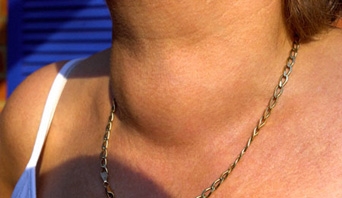

- Increased metabolic rate, therefore hyperactivity and irritability.
- Difficulty in sleeping (Insomnia)
- Sweating
- Heat intolerance
- Graves ophthalmopathy, since the TSH receptors can be found all over our body cells, sometimes the auto-antibodies manage to bind to the TSH receptors on the tissues surrounding the eye.


- Weight loss
- Graves dermopathy


- Faster heartbeat (Tachycardia) which can lead to congestive heart failure (CHF)
- Anxiety
- Hyperreflexia - briefly is the overreaction of the involuntary nervous system to any external stimuli.
- Hand tremors, an uncontrolled rhythm movement of the hand due to abnormal signals in the brain that miscommunicates with the hands and muscles - hand tremors can also happen due to neurological disorders such as dopamine deficiency like in Parkinson's disease ( you can check out this video ( I do not own it) about Tremor disorders: https://www.youtube.com/watch?v=-Y3kex_8UoY)
References
- https://www.youtube.com/user/armandohasudungan
- https://www.youtube.com/user/aimmds
- https://www.youtube.com/watch?v=SCV_m91mN-Q
- http://www.yourhormones.info/glands/thyroid-gland/
Next will be - the effect of anabolic steroids on the thyroid hormones and ultimately the metabolism.


