Chatbox

Tuesday, 21 June 2016

Overview of the lymphatic and immune system Part1


LYMPHATIC SYSTEM


Lymphatic system: It is a network of vessels, organs and tissues containing lymph which is a fluid containing infection-fighting white blood cells that spreads throughout the body.
Also a part of circulatory system and plays a vital role to our immune system
Lymph is the interstitial fluid that gets absorbed when forced out of the capillary tubes.
-One function of the lymphatic system is that it maintains our body's homeostasis.
Homeostasis means balance, a way or process your body does by controlling the concentrations of substances in solution, temperature, etc.. in order to remain everything near constant level, the plasma membrane is so related to homeostasis so check out the last video below for more understanding.
Any failure to perform homeostasis may lead to life threatening consequences such as swelling ankles, lungs can be filled by fluids, the failure to control concentrations can decrease the blood pressure and volume.
Lymphatic system structure:
1-Lymph, a watery(liquid) solution which is most likely to be plasma and NOT blood; because red blood cells are big enough that they cannot squeeze out of your capillaries
Mainly consists of blood plasma which is forced out of your capillaries where the leakage helps the exchange of nutrients and gases between the blood and capillaries and the cells.
2-Lymph nodes, network of lymphatic vessels reabsorb the blood fluid (lymph) which transport them to lymph nodes which are found at certain points throughout the body, they  are more likely to be your checkpoints, they help in monitoring/cleaning/eliminating any microbes or such foreign bodies present in your lymph.
3-Lymphatic organs: a-Spleen( major lymphatic organ) found in a suitable and safe place behind the stomach and just in the front of the left lobe of your liver, spleen has various functions such as getting rid off of dead red blood cells, oxygen-rich blood reservoir and cleans the blood off foreign invaders
b-Thymus gland, a gland that exists in your neck behind the sternum in an appropiate place between your lungs, also provide a vital immunity role to your body by secreting thymosin hormone which stimulates the maturation of disease-fighting lymphocytes called T-lymphocytes
c-Adenoids
d-Tonsils
Both the spleen & thymus provides a safe place for immune cells such as T and B cells, natural killer cells, dendritic cells and R.B.Cs.

Starting from the capillaries......,
The capillaries are tiny, microscopic vessels which connects the arterioles with the venules.
Carries blood from your arterioles and feed blood into venules, their walls which are very thing consists of one row of thing epithelial cells with tiny pores between them, the wall of the capillary is about 0.001 micron thick which facilitates a quick exchange of substances between the blood and the tissue cells.
Capillaries are spread in the spaces present all over the body tissues as a wide irrigation system.
The exchange of nutrients and gases is due to osmotic pressure, it is the diffusion of solutions/substances through a semi-permeable membrane, it increases by the increase in concentration of solutes in solutions.

-About 3 liters per day  of the fluids which is about more than half of your total blood volume  that passes through the blood capillaries are picked up by the lymphatic capillaries that exists through the spaces present in the capillary vessels. Their walls consist of endothelial cells with valves that opens only in one direction, the presence of smooth muscles in the inner lining roles in moving the lymph as well as the skeletal muscles which when squeezing (contracting) increases the pressure on the lymphatic vessels and therefore, the lymph moves forward.

These walls are forced to be opened when the concentration of solutes on the outside is more than that on the inside of the lymphatic vessel. Once filled, it is then taken to various nodes and are eventually drained into two big ducts.
-The right lymphatic duct takes lymph from the upper right area of the Torso, including the right upper arm and right side of the head & thorax feeding all into the Internal Jugular Vein ( a major blood vessel that drains blood from important body organs and parts such as the brain, face and neck, they functions in carrying oxygen-depleted (less) blood from the brain, face and neck and transport it to the heart through the superior vena cava).
-The larger thoracic duct takes lymph from the rest if your body sending them into the subclavian vein.
Lymphatic vessels works under low pressure, containing valve that prevents any back flows as well as the presence of smooth muscles that help in movement and support.
Any decent exercises or movements are good enough to help keep up your lymphatic vessels.
Ultimately, the lymphatic system functions in taking extra fluids and cleans it from any microbes.
Now back to the vital role of the lymphatic system to our immune system, throughout our lives our skin which is considered to be the largest organ is surrounded by many bacteria that standing for any chance to infect your body starting from a small cut in your skin.
For example, staphylococcus bacteria (gram +ve bacteria) sneaks through your loose areolar connective tissue ( a multi-functional tissue that serves structural, adhesive, and immunological functions consists of collagenous fibers and elastic fibers )
Recall lymph nodes....?
Since they contains the checkpoints in other words, the protection against foreign bodies that wants to breach our body, it is also the place for lymphocytes exists (T & B) and where they mature in the loose reticular connective tissue that makes up a large part of the nodes and most of your other lymphoid organs.
-Lymph enters the lymph nodes through a vessel called Afferent vessel  and exits through Efferent vessel
Mucosa associated lymphoid tissues
a.k.a MALTs are also tissues that functions like our lymph nodes such as tonsils (two small masses of lymphoid tissues in the throat), Mucosa? because they are present in the mucous membrane outside the lymphatic vessels, the tonsils inspect everything that you eat, another example is peyer's patches found in the distal portion of small intestines ( consists of a group of lymph nodes) also appendix ( which happens to have lymphatic nodes & vessels)
Figures


Diagram of a lymph node showing its structure


Picture showing the structure of a lymphatic vessel
Diagram of the lymphatic vessel showing its structure and its histology

Loose reticular connective tissue diagram


Diagram showing lymph capillaries in between blood capillaries
Loose areolar connective tissue
I hope you guys enjoyed the topic today, the following videos will help you revise and understand with extra information about the lymphatic system, I don't own any of the following videos also stay tuned for more biology stuff and the next parts of this overview =) WE LIVE WE LEARN
Thanks to Tammy Moore, here is her channel https://www.youtube.com/user/armoorefam
Thanks to CrashCourse, channel's link: https://www.youtube.com/user/crashcourse
Thanks to Jenny Klemme, here is her channel: https://www.youtube.com/channel/UC1WLVcjqO44TPUnV2zvPrcQ
Thanks to Amoeba sisters, link to their channel: https://www.youtube.com/channel/UCb2GCoLSBXjmI_Qj1vk-44g

Next part will be more into the immune system deeper into it, we will discuss immune cells their functions also we will have an example to help in understanding what happens when the body is infected, it will be about bacterial infection.
What you want to know about ''Homeostasis'' is here,

A quick peek about the various body tissues we got

Saturday, 14 May 2016

Measles - how it spreads, brief notes on how it infect us and it's cure


MEASLES

Structure and taxonomy
Measles is a single stranded enveloped RNA virus surrounded by a protein coat, Genus: Morbilivirus, Family:Paramyxoviridae, it's host has always known to be human host cells and it's common infection in children also a very infectious disease. (See FIG.1)

Notice: you need to be aware of some of the Immune system's cells in order to understand some of the next questions.

It's TRANSMISSION

Measles is said to be one of the most infectious diseases( an airborne viral disease), it can be transmitted through several ways such as sneezing, coughing, measles can live for a couple of hours in the air which therefore can be transmitted through breathing and touching things contaminated with the virus.

DIAGNOSIS

Diagnosing measles virus can be performed through several ways such as: blood test, urine test or throat swab (see fig.2 to know what throat swab is)

Whom are most likely to be infected with measles?
-The elderly, very young individuals (can lead to their death), pregnant women, immunosuppressed individuals and those who are malnourished.

Mechanism of prevailing in our body.

Measles can enter our body through nose, mouth or eyes, measles is especially good at infecting our body's first line of defense within our lungs ( the beginning of infection) cells called Macrophages these cells exists all over our body and usually known as powerful eaters where they have the ability to devour foreign bodies up to 100 of them, it uses the macrophages' cell machinery and reproduce itself through the cells resources until the cell is full of viruses, they leave it and begins the cycle all over again. Fortunately, our immune system has some powerful immune cells called ''Natural killer cells'' these cells main job is to patrol the entire body and check other cells for infection, in case they find an infected cell they order it to commit a suicide through messenger proteins by a process called '' cell signaling''.

Measles symptoms usually are to be noticed after like 10 to 12 days ( Incubation period), after a period of time, macrophages alerts the BRAIN of the immune system ''Dendritic cells'', the dendritic cell's job is to collect samples of the intruders, travel to the lymph nodes and then activate the heavy weapons that erases the virus. Unfortunately, the measles virus uses such a mastermind or a dreadful tactic just like what is said in the video down below, it infects the dendritic cells and travel to lymph nodes and starts infecting your immune vault, the soldiers of your body "B & T lymphocytes), at last the lymph system spreads the virus everywhere infecting lots of organs and damaging many cells.

Now the symptoms of measles virus starts showing up, it infects various organs such as the spleen, intestines, liver, the lung, some cases infects the brain, etc..

Leading to a very high fever, headache, sickness, bronchitis, rash ( shows up at the beginning of infection sometimes) and much more..

The lymph system is weakened at the current moment making a chance for bacteria and other viruses that would take a chance of this and develop into secondary infections that can cause Pneumonia, at this stage our bodies are completely in an exhaustion giving an advantage of the virus to take over YET our body is far and away from giving up which is kind of a tremendous and fascinating thing to be proud of being a persistent and it fights back furiously, some of our dendritic cells survive long enough, they then activate our heavy weapons (T and B lymphocytes) B lymphocytes which then differentiate into ''Plasma cells'' that produces billions of antibodies a.k.a Immunoglobulins '' Y shaped tiny protein molecules that mark infected cells for destruction or clump the viruses, they consist of heavy chains and light chains'' T lymphocytes spread all over the body and kills infected cells.

About time now for our immune system to take a consideration of such disease by ordering some immune cells to save the specific type of antibody this virus needed to be obstructed and recognize the virus in case of it made a comeback.

IT'S CURE.

The best way to prevent measles is vaccination which became normally found in childhood vaccinations programmes, although some people cannot get vaccinations such as pregnant women, people who has immunosuppressions, chemotherapy patients or those who are diagnosed HIV-positive.

They does that by doing a process called ''Cell culture adaptation'' which allows the virus to reproduce in a medium that isn't human cells, this is done by injecting the virus in chicken embryos in a petri dish making the virus adapt to this type of infection ( chicken ) they are adapted to infect chicken cells since measles reproduces a lot they inject the individual with this virus which is weak comparable to human cells reproduces about 20 times this reduces the symptoms but activate immune response.

We can still are able to help find other ways to stop the disease from spreading for those people just like how we could make it with ''smallpox''

Thanks to Kurzgesagt, SciShow and Let's learn about bugs for making this easy to understand.

I don't own any of the following videos, they are only brought to help you understand brief notes about measles, so helpful and useful videos and I hope you guys find this informative.

Here are links to the YouTube channels I got these videos from:

https://www.youtube.com/channel/UCZYTClx2T1of7BRZ86-8fow

https://www.youtube.com/channel/UCsXVk37bltHxD1rDPwtNM8Q

https://www.youtube.com/channel/UCSktYEB73WQ3mOOLyBfRsPA

Also thanks to http://www.who.int/immunization/diseases/measles/en/
Keep tunned for more biology-related topics!
FIG.1

FIG.2


Saturday, 7 May 2016

Pancreas- brief notes

The Pancreas 


Pancreas is considered to be a mixed gland. this organ controls our body's sugar level and produces a special juice called pancreatic juice that literally releases the nutrients present in any meal you have eaten so it has a role in our Metabolism, the pancreas is situated behind our stomach see Fig.1 which means that one of its main functions is to assist in breaking down food through a mixture made of water, sodium bicarbonate and digestive enzymes.


Sodium bicarbonate's role is to neutralizes the stomach's acidity so as to let the digestive enzymes perform their functions, enzymes such as Lipase, Protease, and Amylase. (exocrine function) these digestive enzymes are secreted from cells called Acinar cells see Fig.2

Lipase breaks down the fatty substances

Protease help in splitting up proteins

Amylase divides carbohydrates into energy-rich sugars

So these past three enzymes have a great role in our metabolism, another function of the pancreas which is considered to be crucial is controlling the amount of sugar in the human's blood through two hormones:

Insulin and glucagon which are produced from special small glandular cells in the pancreas called the Islets of Langerhans (endocrine function) see Fig.3 the islets of langerhans has two types of cells (alpha & beta cells) see Fig.4

The alpha cells are usually small in number and secretes glucagon hormone, this hormone is secreted only when the blood sugar level is falling down or too low, by telling the cells and livers to release sugar in the bloodstream, converting the stored glycogen for example in the liver to glucose.

The beta cells represents the majority of cells and secretes a hormone called insulin which antagonizes the action of glucagon. Mainly it makes the excess sugar moves back to the cells, it stimulates the oxidation and utilization of glucose by the cells as it is important for transport of all monosaccharides (except fructose) across the cell membrane also stimulates the conversion of glucose to glycogen ( to be stored in the liver or muscles) or to lipids.

We can say that the balance between insulin and glucagon is what keeps our body's health maintained but any failure in either the secretion of insulin or glucagon can lead to a condition called Diabetes Mellitus, the increase in glucose level in the blood is associated with abnormal appearance, excretion of glucose in urine with the excretion of large volume of water which explains the symptoms of continuous thirst sensation and excessive micturition, blood vessels becomes hardened, heart attacks, kidney failure and strokes.

Also from what we learn from this video is that people who have diabetes their body tends to have high glucagon level which increases the sugar level making it worse.

The pancreas is more like an instructor that guides our body to maintain a good health.
Like and share it please incase you find it informative to let everyone knows about this important topic.
Also follow our facebook page for more biology-related topics! https://www.facebook.com/biologyclub17/
Thanks to #TedEd for developing this video which is full important and helpful notes
Fig.1
Fig.2

Fig.3

Fig.4


Thursday, 5 May 2016

Alzheimer's disease


Alzheimer's disease


Well most of us have a very narrow knowledge related to this magnificent disease which is Alzheimer's disease, In my point of view and my anticipations says that most of those whom I know knows only that Alzheimer means memory loss, well yes it is but that's not only its symptom, Alzheimer's disease is kind of a successful disease (a brain disorder); due to a couple of reasons but firstly, it has been discovered in 1906 by Dr. Alois Alzheimer a German psychiatrist, and guess what people 110 years since its discovery yet none ever could find a cure to eliminate Alzheimer's disease, the only treatment reached so far are only made to slow its progression.
To be honest in front of you all, I am really afraid since the day I have read about this disease, it scares me and I felt so sorry for those who has it and those who died of it. God be with you.
Anyway, Alzheimer's disease not only loosens its patient his memory but also it causes several damage to him, Symptoms starts by: 1)Short memory loss
2)Lack of the ability to perform logical thoughts
3)Erratic mood changes (through infecting the part that controls emotions in the brain)
4)Paranoia and hallucinations
5)Long term memory loss
Eventually 6)It takes over the control centers leading to a fail in pumping blood as well as breathing resulting to death.
How Alzheimer's disease progress ?
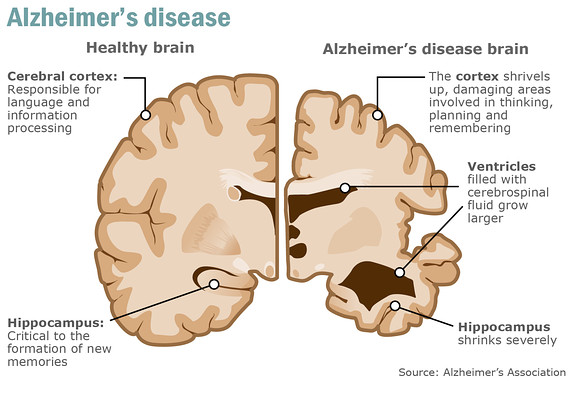
Through an autopsy( an examination that is done to the person after his death (corpse) to evaluate and identify the reasons of the death through a highly surgical operation, they found out in the brain structure the presense of misfolded proteins ( meaning they are not in their suitable or right place) Protein folding is a process by which the protein molecules tend to attach together in order to arrange its functional shape, the misfolded proteins are called plaques (are small differentiated areas on the body surface or on organs such as the brain in our case) plaques are formed when an enzyme slices the fatty membrane surrounding the nerve cells (mylein sheath) resulting in beta-amyloid proteins ( these proteins' role is neural growth and repair any damage ) but any corrupted form later in life leads to the lose of memory among other things, they then group together due to their sticky status which form what we mentioned ''plaques'' their grouping blocks the cell signaling such as any messenger proteins and pulses and therefore the communcation between cells, these defected cells due to the formation of these plaques and tangles lead to the triggering of immune reactions causing the destruction of the disabled nerve cells and also found neurofibrillary tangles neurofibrillary (nerve fibers) tangles ( grouping) so neurofibrillary tangles are the grouping of nerve fibers in a confusing way making a complex structure, they are built from a protein known as tau ( tau protein is a protein that tends to stabilize the microtubules found in the neurons of the central nervous system which is more likely to be a network that receives oxygen, food molecules and nutrients to the brain's nerve cells.

In Alzheimer's disease these proteins becomes twisted strands meaning the passage of nutrients to the brain's nerve cells are obstructed which leads to the death of these cells eventually.

Follow my page on facebook to keep yourself posted! https://www.facebook.com/biologyclub17/


Just in case everyone since I have noticed the video is not working properly, here is a direct link to the video on youtube I am so sorry: https://www.youtube.com/watch?v=yJXTXN4xrI8

Figure showing how Alzheimer's disease on the brain
Thanks to Alzheimer's association for developing this picture showing us the result of the destructive pairing of plaques and tangles on some brain parts


Monday, 2 May 2016

Thyroid gland-brief notes


Thyroid gland


In contact with the trachea, lies a powerful gland named as Thyroid gland, a gland that has an enormous power over our body.Structure: consists of two lobes, each one has lobules, these lobules contain cells named follicles, functioning as a store to the hormones the thyroid gland se

nds, they are Thyroxine& Triiodothyronine or T3 and T4 respectively so Iodine is an essential element that mainly build up these hormones.

The thyroid gland has various functions and effects over the human body, it's role is to ensure the proper work of the body's cells by delivering these hormones to every single cell, it instruct every cell when to consume oxygen for aerobic respiration and nutrients for maintaining the body's metabolism that means it has a major function in our physical and mental growth, it makes sure that our heart pumps blood properly.
The thyroid gland is controlled by the human body's MASTERMIND gland which is the ''Pituitary gland'', this gland can be found deep below brain, it makes sure when the thyroid gland secrets it's hormones, the pituitary's role is to sense if the hormonal levels are too low or too high by secreting a hormone named ''TSH'' thyroid stimulating hormones which induce/stimulates the thyroid gland.

Everything has disorders, 1st:Hyperthyroidism where the thyroid gland sends a lot of hormones that means the cells are overloaded with instructions making the individual overactive experiencing a high metabolism signaled by:1)faster heart beat 2) constant hunger 3)high weight loss 4) sleep difficulty and much more
On the other hand, 2nd disorder: Hypothyroidism where the thyroid gland sends a few hormones that means cells doesn't have many messengers to guide them, therefore, metabolism diminishes to a low level. signaled by:1) high weight gain 2) sluggishness( delay) ( lag) 3)sensitivity to cold 4) swelling joints 5)depression and much more
Well I really have to admit that the study of hormones is amazing, we can literally say it is what our metabolism based on, it is the key the ignites our metabolism.


Thanks to ‪#‎TedEd‬ for developing this informative video.
If you understood it well, go ahead and try answering these six easy questions on http://www.sporcle.com/games/ahmedmaxi93/about-thyroid-gland

Join our facebook page for more biology posts!! https://www.facebook.com/biologyclub17/


A picture showing the position of thyroid gland

Here is another picture expressing thyroid gland's dysfunctions


Thyroid gland in a nutshell